What happens when you call for a flatbed tow truck
New Bedford Towing sends a flatbed tow truck whenever the vehicle should not have a wheel turning on the road - all-wheel drive, electric, lowered, a classic, a motorcycle, or anything that will not roll or steer after a crash. Most of the call is us asking questions, because the answers decide which truck we send.
First the year, make and model. Then the drivetrain: all-wheel or four-wheel drive, electric or hybrid, lowered, or a motorcycle. Then whether it rolls and steers, where it is, and where it needs to go. The front-wheel-drive and all-wheel-drive versions of the same car look identical at the curb and need different trucks.
If it is in a live lane or on the shoulder of I-195 or Route 140, say so first: that is emergency towing after a breakdown or crash, and we route the truck differently. In a driveway or a garage we ask about the approach, since a steep apron or a low ceiling decides where the bed can come down.
We tell you the arrival window on the call and quote the total before the truck rolls, around the clock: 24-hour towing in New Bedford means a flatbed at two in the morning as readily as at noon.
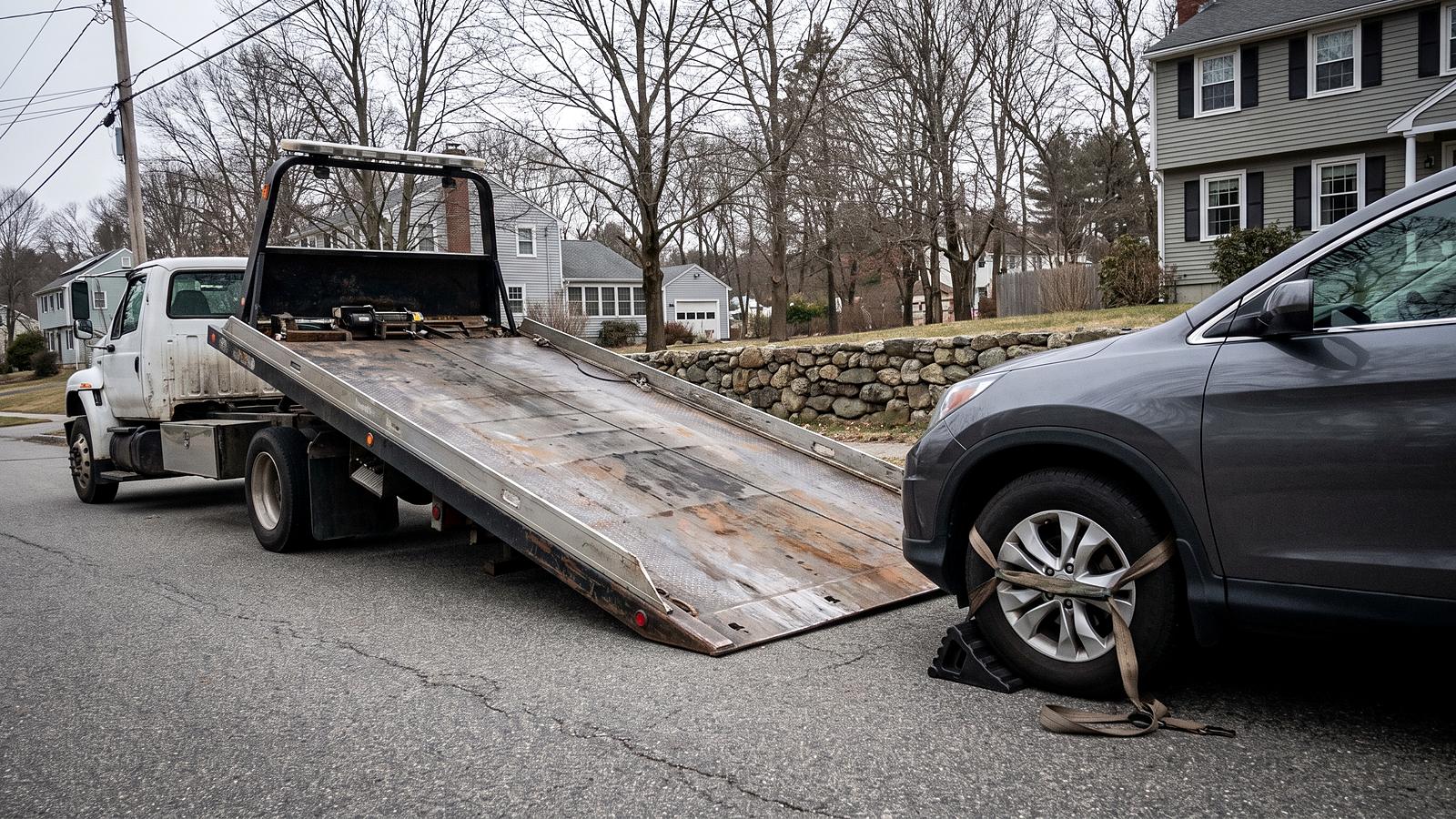
On arrival the driver photographs the vehicle, sets the truck so the bed tilts in line with it, runs the winch line out, hooks to the tow points or fits wheel straps, and brings it up slowly. Strapped at four corners with the bed level, nothing touches the road but the truck's own tires.
What a flatbed towing quote in New Bedford depends on
A flatbed you call for yourself is a consensual tow: Massachusetts caps rates only for police-ordered and trespass tows, under 220 CMR 272, and the DPU says it does not regulate towing requested by a vehicle owner. So the quote is ours to make, and we make it on the phone, as one total, before anything moves.
Distance is the big one. A hop across town - Downtown to a shop in the North End, a South End driveway to a dealer off Route 140 - is a local tow. Fall River, about 14 miles out on I-195, and Wareham, about 17, are priced by the mile, and Boston, Providence or the Cape are quoted on the miles and the hours the truck is away.
Where it goes matters too: a shop with set hours, a dealer that wants the key in a particular place, or a street with nowhere to set the bed down all add handling time. Tolls on the route go on the quote, named before you agree.
Loading time is the other lever. A vehicle that rolls and steers winches up in one pull; one that will not - locked steering, a seized brake, a parking pawl that will not release - needs dollies under the dead corner or the truck repositioned, and that time is quoted up front. A car nosed into a snowbank needs recovery before the vehicle can be loaded, quoted as its own job.
The cost page walks through the mileage and distance drivers of a flatbed quote, and the state caps that apply only when police or a property owner ordered the tow.
Why AWD, EV and motorcycle towing belongs on a flatbed
AWD and 4WD
A wheel-lift picks up one end of a car and lets the other end roll. All-wheel drive is the first reason not to: the front and rear axles are linked, so lifting one end and rolling the other turns the driveline from the road. AAA calls flatbeds "ideal for all-wheel and four-wheel drive vehicles" and warns: "If you drag the front wheels, your transmission could get damaged." Nissan's bulletin on flat towing says of 4WD and AWD automatics: "DO NOT Flat Tow - doing so will damage internal transmission components" and "DO NOT use a tow dolly - doing so will damage drivetrain components." Subaru's manual says never to tow an AWD model with only one axle raised, citing the center differential, and calls for a flatbed if the transmission fails.
Electric and hybrid vehicles
Tesla's Model 3 manual is plain: a flatbed "is the recommended method of transporting" the car, and the tires must never be in a position where they can spin, because that "can lead to significant damage and overheating." If no flatbed is available, wheel lifts and dollies must be used, limited to 35 miles. Tow Mode lets the tires rotate slowly, under 5 mph and for less than 30 feet - enough to winch the car onto the bed - and damage from improper transporting is not covered by the warranty. Hybrids and plug-ins get the bed by default too.
Lowered, classic and low-clearance vehicles
A lowered car or an older car with a long front overhang cannot take a wheel-lift's boom under its nose, or a steep ramp. AAA calls a wheel-lift a "poor solution for exotic, classic or luxury vehicles" and the flatbed "ideal for towing exotic or low riding vehicles." Our part is the angle: the bed at its shallowest, blocks under the ramp where a driveway drops away, and a slow pull with someone watching the front lip. Straps go over the tires rather than J-hooks to the frame.
Motorcycles
A motorcycle rides the bed upright, rolled forward until the front wheel hits the end of the wheel chock, with soft straps, padded where they touch paint or chrome. The straps are snug, not cranked: U-Haul's loading guide warns that overtightening "could make your suspension bottom out and damage parts when towing," and calls the center stand "the most stable way for the bike to sit on a flatbed." Harley riders, put the bike in transport mode first; it disables the security system's motion detection, and otherwise, as one Harley dealer's guide puts it, the alarm "can continuously trigger during transit, slowly draining your battery."
When a wheel-lift will do, and when long distance towing needs the bed
Not every tow needs the bed, and we will say so. A front-wheel-drive car towed from the front, drive wheels up and rear wheels rolling, comes to no harm, and a short hop - a Near North End driveway to a shop off Kempton Street - is quick work for a wheel-lift.
Dollies are the middle case: small wheels under the second axle, so a wheel-lift can move a car that must not have either axle rolling - a front-wheel-drive car with a crushed front end, lifted from the back, or an electric car with no flatbed within reach, which Tesla limits to 35 miles. They are no answer for an all-wheel-drive automatic; Nissan rules them out, and so do we.
Sometimes the answer is no truck at all: a dead 12-volt battery, a flat with a usable spare or an empty tank is roadside help that avoids a tow altogether, and we would rather send that.
Long-distance and out-of-area transport
For long distance towing the flatbed is the only truck we send: a wheel-lift asks something of the vehicle every mile, a flatbed asks nothing. From New Bedford that means Fall River, about 14 miles along I-195, or Wareham, about 17 the other way; Route 140 north to Route 24 toward Boston; and Providence or the Cape. We quote it by the mile, name the tolls, and give a delivery window at the far end.
Dealer and body-shop deliveries
Most of those runs end at a service bay - a dealer, a body shop, a specialist for that make - so we call ahead, set the car down where the shop wants it, hand over the key the way they ask, and keep loading and unloading photos with the paperwork.
Put the car in neutral only when the driver asks for it - a car in neutral on a slope moves. Leave the parking brake off once it is strapped to the bed; the straps do the holding. Take your personal items and the garage remote before the truck leaves.
Flatbed towing across New Bedford and the SouthCoast
We run the flatbed through the whole city - Downtown, the North End along The Ave, the Near and Far North End, the South End and the West End - and along I-195 at Exits 24A and 24B for Route 140, 26 for Route 18, 27 at Washburn Street, 28 at Coggeshall Street and 29 for Route 240, plus US 6 on Kempton Street and Mill Street before the swing bridge to Fairhaven.
Two routing facts we live with: the New Bedford-Fairhaven bridge opens about 5,000 times a year, daily for the fishing fleet, so a run to Fairhaven can wait on a boat, and until the summer of 2027 the ramp from I-195 westbound at Exit 26 to Route 18 southbound is closed for the interchange rebuild. Both are in the arrival window we give you.
The same truck covers the neighboring towns: Fairhaven, about 2 miles across the bridge on US 6; Dartmouth, about 4; Mattapoisett, about 7 along US 6; Acushnet, about 8; Westport, about 11; Freetown, Fall River and Marion, all around 14; and Wareham, about 17 miles out on I-195. Those are center-to-center figures; the quote follows the real route.
Two pickup points come up often. The ferry parking at State Pier - Seastreak to Martha's Vineyard and Nantucket, the Cuttyhunk Ferry at the foot of Union Street - is where a car left for a few days comes back to a dead battery and, if a jump will not do it, a tow. The other is the MBTA lots: New Bedford station at 536 Acushnet Avenue, with 352 spaces, and Church Street station at 387 Church Street, with 354. Tell us the lot and the row.
Frequently asked
Why does an all-wheel-drive car need a flatbed?
New Bedford Towing puts all-wheel-drive and four-wheel-drive vehicles on a flatbed because the front and rear axles are linked, so towing with one end rolling turns the driveline. AAA is blunt: "If you drag the front wheels, your transmission could get damaged." Nissan says not to flat tow or dolly a 4WD or AWD automatic, and Subaru warns about the center differential.
Can an electric car be towed?
Yes. New Bedford Towing tows electric cars on a flatbed, which is what Tesla's owner's manual asks for: it calls a flatbed the recommended method, says never to transport the car with the tires in a position where they can spin, and limits a wheel-lift with dollies to 35 miles. Tell us the make and model and whether it will power up.
Does New Bedford Towing tow motorcycles?
Yes. New Bedford Towing carries motorcycles on the flatbed, not a wheel-lift, which AAA calls a poor choice for motorcycles. The bike goes into a wheel chock, on its center stand where it has one, with soft straps padded where they touch and snugged rather than cranked so the suspension does not bottom out. A Harley goes into transport mode before we load it.
How far will you tow a car?
As far as it needs to go. New Bedford Towing runs local flatbed tows across the city and the neighboring towns, and long-distance transport to Fall River, Wareham, Boston, Providence or the Cape. Distance is the main thing that moves the quote, and we give you the total by the mile before the truck rolls.
Can you tow a lowered or classic car without damage?
Yes, on a flatbed. New Bedford Towing does not put a lowered, classic or low-clearance car on a wheel-lift, which AAA calls a poor solution for exotic, classic or luxury vehicles. We set the bed at its shallowest, bring the car up slowly with someone watching the front lip, and strap over the tires rather than hooking the frame.