Roadside assistance in New Bedford: what happens when you call
New Bedford Towing answers calls for roadside assistance in New Bedford around the clock, and the first minute of that call decides what goes on the truck. We ask two things first: what the car is doing, and exactly where it is.
What the car is doing tells us the job. One click and dim dash lights point at the battery. A strong crank that never catches points at fuel or spark, and no jump pack fixes that. A thump and a pull to one side is a tire.
Where it is tells us how to reach you. A street and a cross street is enough in the West End. On I-195, give us the direction and the nearest exit: 24A and 24B for Route 140, 26 for Route 18, 27 at Washburn Street eastbound, 28 at Coggeshall Street westbound, 29 for Route 240. On Route 18, say which way you were headed on the JFK Memorial Highway, because the ramp from I-195 westbound to Route 18 southbound is closed until the summer of 2027 and we route around it.
Then we give you the arrival window and the price on the call, and leave with the roadside kit on board: a jump pack, a jack and impact tools for the lug nuts, fuel for the car you described, and the lockout tools. That is why the first visit is usually the fix, and when it is not, the same call becomes a tow rather than a second phone call.
What does roadside assistance cost in New Bedford?
A roadside visit is priced as a service call: one trip to the car, the time on scene and the work done there. A tow is priced as a tow: the hook-up, then the miles the car rides on the truck. The same dead battery costs less to jump in your driveway than to carry to a shop.
Massachusetts caps what a company may charge for a police-ordered or trespass tow under 220 CMR 272 and sets no cap on a service you call for yourself, so the quote is the whole agreement, and we give it before the truck rolls. The cost page lays out what a roadside call costs compared with a tow.
What moves the price of a roadside call:
- Distance to reach you. A call in the North End is one thing; a call out past Westport or up in Wareham adds road time both ways.
- Fuel delivered. On a fuel run you pay for the gas or diesel itself on top of the visit.
- Time on scene. A jump is quick; a lockout with the keys shut in the trunk, or a seized lug nut, takes longer, and we say so when we quote it.
- A fix that will not hold. If the battery dies again before the end of the street, the visit becomes a tow, quoted as a tow, and you hear the new total before the car goes on the truck.
Jump starts, tire changes, fuel delivery and lockouts
Jump start
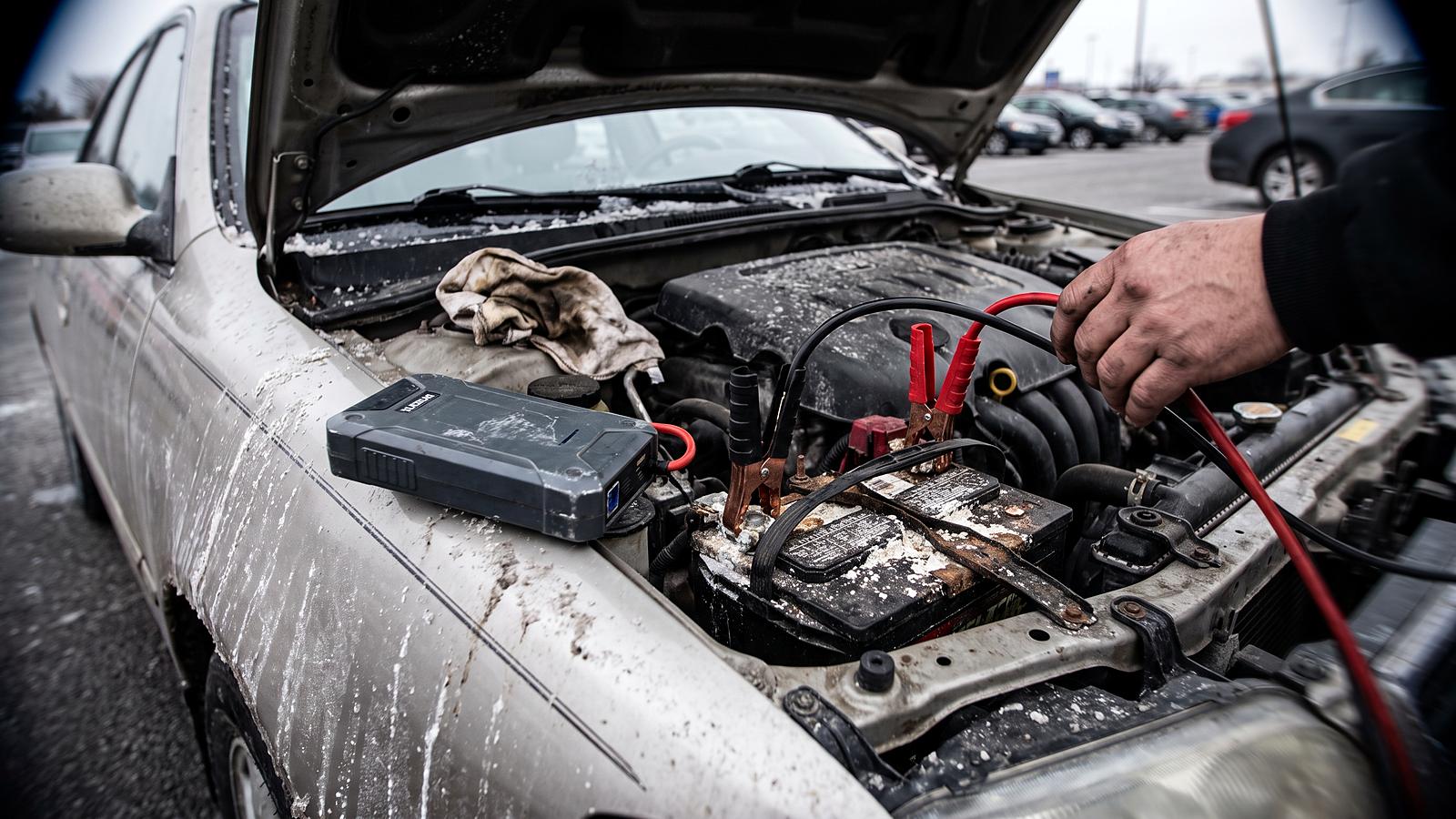
A jump start is the most common roadside call we take in New Bedford, and most come between the first hard frost and the last. AAA puts it plainly: at 32°F a battery loses about 30% of its strength while the engine needs about 30% more energy to turn over, and at 0°F the engine's demand rises to 50% more. A battery that was fine in October has less to give in January.
We put a jump pack on the terminals, get the engine running, and check that the charging system is doing its part before we leave. Then drive for a while, not around the block, so the alternator can put something back.
A jump will not hold when a cell has frozen, the battery has an internal fault or the alternator is not charging: the car runs on what the pack gave it and dies a few streets later. If the engine starts and stalls, or the battery light stays on, the visit becomes a tow to a shop.
Flat tire change
With a spare on board, we jack the car, pull the flat, mount the spare, torque the lug nuts and check its pressure, because a spare loses air sitting in a trunk for years. A donut is meant for a limited distance at reduced speed, so the next stop is a tire shop, not the highway home to Fall River.
More cars now come with no spare. Run-flats are built to be driven a short way after losing pressure, so the TPMS light may be the only sign; an inflator kit seals a small tread puncture and does nothing for a sidewall cut. No spare and a tire that will not hold air means a tow to a tire shop, and we say so on the call.
If your wheels have locking lug nuts, find the key before we arrive - usually the glove box or the bag with the jack. Without it the wheel is not coming off at the roadside.
Fuel delivery
Running out of gas is the call people apologize for, and there is no need. We bring enough fuel to reach a station, not a full tank, and we ask on the call whether the car takes gas or diesel, because the wrong one turns a small problem into a shop visit.
Modern cars carry the fuel pump inside the tank, where the fuel keeps it cool; run the tank dry and the pump runs hot and pulls in whatever settled at the bottom. One dry tank rarely ends a pump, but it is a reason not to make a habit of it. Some cars need a few seconds of cranking to prime the lines; we stay until yours catches.
Vehicle lockout
Keys locked in the car, keys shut in the trunk, a fob that died at the worst moment - we open the door with tools made to spare the paint, the weather strip and the lock. On most cars that is an air wedge and a long-reach tool; on some it is a pick, which is why we ask the year, make and model.
Have your license ready and, once the door is open, the registration. We open a car for the person it belongs to.
If a child or a pet is locked in the car, call 911 first, then call us. A closed car heats fast on a warm day, and a broken window is a cheap fix. We will still come, but do not wait on us.
When a tow is the right call instead of a roadside fix
Some calls come in as roadside and go out as a tow. We send a tow truck from the start for:
- A warning light with the engine running rough. A flashing check-engine light or an oil pressure light means stop, not jump.
- Overheating. A gauge in the red or steam from under the hood is a cooling system problem; nothing in the roadside kit fixes it.
- A battery that dies again within minutes of a jump. That is a charging system that has quit or a battery that will not take a charge; a second jump gets you exactly as far as the first.
- A flat with a damaged wheel. A bent rim, a cracked alloy or a tire that came apart at speed is not a spare-tire job.
- A car that will not shift out of park. A parking pawl that will not release, a failed shift interlock or a dead battery behind an electronic shifter all mean the drive wheels come off the ground on a truck.
In those cases we send an emergency tow when the roadside fix will not hold. An all-wheel-drive, electric or low car rides on flatbed transport to a shop with all four wheels off the pavement, which is what the owner's manuals for a Tesla or an all-wheel-drive Subaru ask for.
The reverse is also true. One click after the coldest night of the year, a tire that went soft overnight, keys in plain view on the seat - those are roadside calls, and a tow would be paying for a truck you do not need.
Roadside service across New Bedford and the SouthCoast
The roadside kit rides the same routes as our towing service across New Bedford: Downtown, the North End along The Ave, the South End, the West End, the Near and Far North End, and the towns around us. Fairhaven is about 2 miles over the bridge on US 6, Dartmouth about 4, and Fall River, Marion and Wareham sit 14 to 17 miles out along I-195.
The calls that repeat come from where cars sit. Commuters at the MBTA lots - New Bedford station at 536 Acushnet Avenue and Church Street station at 387 Church Street, about 350 spaces each - come back to a battery that quit while the car sat all day, and ferry passengers home from Martha's Vineyard, Nantucket or Cuttyhunk find the same where they parked for the boat at State Pier.
In a parking garage - the Elm Street or Zeiterion garages, say - tell us the garage and the level, because ceiling height decides which truck can reach the car if it needs a tow. Near the water, from the working waterfront to the hurricane barrier - the earthfill dike across the harbor between New Bedford and Fairhaven - salt air is hard on battery terminals, so the posts get a look as well as the battery.
Frequently asked
Will a jump start fix it, or do I need a tow?
New Bedford Towing starts with what the car does when you turn the key. One click, or nothing with dim dash lights, is usually the battery and a jump gets you going; a strong crank that never catches is fuel or ignition, and a jump does nothing for it. If the car starts on the pack and dies again within minutes, the answer is a tow.
Why do car batteries die in New Bedford winters?
Cold cuts what a battery can give at the same moment the engine asks for more. According to AAA, at 32°F a battery loses about 30% of its strength while the engine needs about 30% more energy to start, and at 0°F the engine's demand rises to 50% more. New Bedford averages 32.5 inches of snow a year by NOAA's 1991-2020 normals, so a marginal battery tends to quit on the first hard cold snap.
Can you change a tire if I have no spare?
New Bedford Towing can only mount a tire you have, so with no spare the roadside visit becomes a tow to a tire shop. Run-flats may be driveable a short way at low speed; an inflator kit seals a small tread puncture but not a sidewall cut. Tell us on the call whether there is a spare, and we send the right truck.
Do you deliver fuel, and how much?
Yes. New Bedford Towing brings enough gas or diesel to reach the nearest station, not a full tank, and you pay for the fuel on top of the service call. Tell us which fuel the car takes and where you are; if it will not restart once the fuel is in, we are there to work out why.
Can New Bedford Towing unlock my car?
Yes. New Bedford Towing opens locked cars and trunks with lockout tools made for the job, and asks for the year, make and model on the call because the method depends on the car. Have your license ready. If a child or a pet is inside, call 911 before you call us.