Winch-out and recovery in New Bedford: what happens when you call
New Bedford Towing pulls cars out of snowbanks, ditches, sand and flood water around the clock, in New Bedford and the towns around it. A recovery is not a tow with a longer cable - it is its own job, and the first thing we do on the call is work out which job it is.
If anyone is hurt, or the car is stopped where traffic cannot see it in time, call 911 first; police can close a lane and we cannot. Then we ask four things.
- How far off the road it is. Two wheels off the pavement is a short pull; forty feet down an embankment means line run out and time.
- What it is sitting in. Snow, sand, mud, water and a plow ridge each grip a car differently and change how we rig the pull.
- Whether it is on its wheels. A car on its side or roof is rolled back over first, with different straps and often a different truck.
- Where you are, exactly. Street and cross street, lot name, or highway, direction and exit.
We quote the whole job and give you the arrival window on the call, and if the car will need an emergency tow after the recovery because it will not start or steer, we say so before the truck rolls.
What a recovery costs in New Bedford, and what moves the price
A straight tow is a known quantity: hook, load, drive, unload. A recovery is not, because nobody knows how a car will come out until the line is loaded. The cost page explains why recovery is quoted differently from a straight tow; the short version is four things.
- Time on scene. Digging out, resetting the anchor and pulling in stages all take time, and that is the biggest single variable in a recovery.
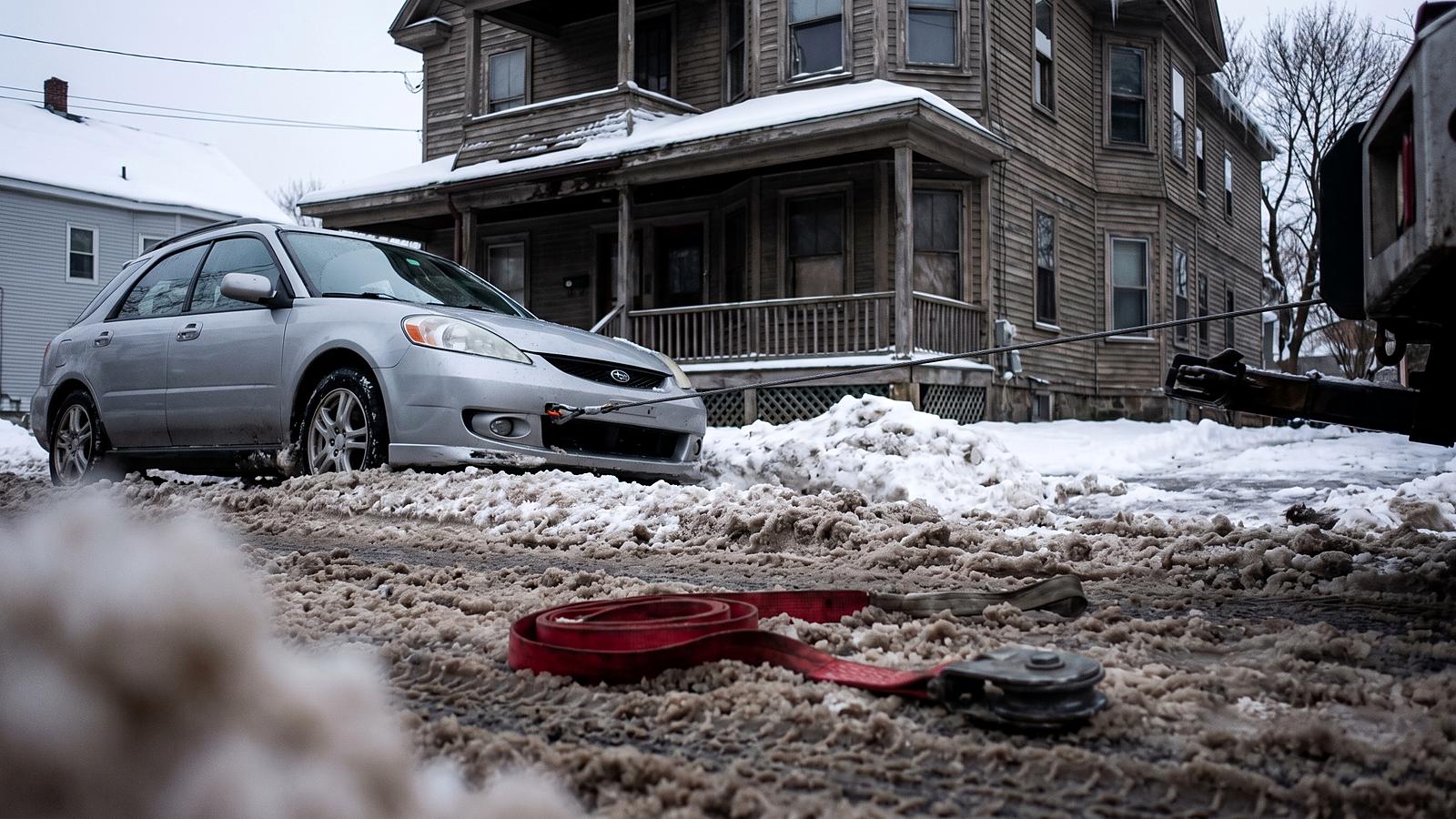
- Rigging. One winch line to a frame hook is the simplest pull. A car deep in a ditch may need a snatch block to double the pulling power and soft straps so nothing bends.
- A second truck. When there is no safe angle, or a car has to come back up a bank without rolling, a second truck holds it while the first pulls.
- Whether a tow follows. Some cars drive away from a recovery; some do not, and the tow to a shop is a separate line on the same quote.
Massachusetts caps what a tow company may charge for a police-ordered tow under 220 CMR 272, and separately allows additional labor, a second service vehicle and extraordinary services at actual cost - the state's own acknowledgement that recovery is not a flat job.
A recovery you call for yourself is not rate-regulated at all, which is why we give you a total before the truck moves, not an open-ended hourly rate.
What a winch-out involves: snow, ditches, crashes and water
Snowbanks and plow ridges
New Bedford averages 32.5 inches of snow a year on the NOAA normals, much of it from nor'easters, the coastal storms that bring heavy snow and gale-force wind between September and April. That is when cars go into snowbanks: sliding on the turn into a side street, misjudging the curb under a drift, or nosing into the ridge a plow left across a driveway.
A snow emergency adds to it: the parking ban runs for 48 hours and cars that do not move are ticketed and towed at full cost. Overnight on January 18 and 19, 2026, the city towed 170 vehicles under that ban - a lot of cars in the wrong place, and a lot of drivers spinning them into the plow bank.
The pull is usually simple: straight back along the car's own tracks, where the tires have already packed the snow. A car sitting on top takes a recovery strap and a slow, steady pull; one that has dug in takes the winch line, and a snatch block if it is buried deep. What we never do is spin the wheels: that polishes the snow under the tire into ice and drops the car lower, so the first thing we say on the phone is to stop.
Ditches, soft shoulders and sand
The South End has three miles of shoreline, and the sand does not stay on the beach. A car that drops a wheel off the pavement onto sand sinks fast, because sand gives way under a spinning tire like snow. A soft shoulder after a week of rain does the same, along Route 140, Route 6 and side streets with no curb: the grass looks solid and the wheel goes down to the hub.
A car stuck in mud or sand comes out in the direction it can move. If the front wheels are in a ditch, we winch from the rear and lift the front as it comes; if it is high-centered, we lift one end first so the floor pan is not dragged. Straps go to the wheels or the tow points, never an axle or a control arm, and the pull is slow enough to stop the moment something starts to bend.
After a crash
Accident recovery is where sequence matters most. A car on its side or roof is rolled back onto its wheels first, with the straps set so it lands on its tires, not its suspension; then it is dragged clear of the lane, and only then does the tow begin. A car that has hit something hard often cannot roll - a bent knuckle, a folded wheel - so loading a damaged vehicle on a flatbed is done with the winch line, not by driving it up the deck.
If the police ordered the tow, it is a police-ordered tow and Massachusetts caps the charge; if you called us yourself, it is a consensual tow and the state sets no cap.
A loaded winch cable stores a great deal of energy, and if a hook or strap lets go it comes back along the line faster than anyone can move. Never stand in line with the cable while we are pulling, and keep passengers, children and neighbors on the sidewalk until the car is on pavement and the line is slack.
Water and floods
The hurricane barrier protects about 1,400 acres of New Bedford, Fairhaven and Acushnet from tidal flooding, per the Army Corps of Engineers, but it does not keep every street dry. A nor'easter at high tide still pushes salt water over low roads - the February 2026 storm was forecast with coastal flooding at high tide - and cars get driven into water deeper than it looks.
We can winch a car out of a flooded street once the truck can reach it, but a car that has been in salt water is a flatbed job, no exceptions. Salt gets into the wiring and the brakes and keeps working long after the carpet is dry, so it is not towed with two wheels turning and not started; it rides the deck to a shop before anyone turns the key.
What not to do while you wait, and when a winch-out is the wrong call
Most of the damage we see on a recovery was done before we got there, by people trying to help.
- Do not rock it until it digs in. A gentle rock in the car's own tracks with the wheel straight can free a car that is barely stuck. The moment the wheels spin without the car moving, stop: every spin drops it lower and turns a strap job into a winch job.
- Do not let a passer-by pull it with a strap on a tow ball. A tow ball is built for a trailer's steady weight, not a shock load; when one shears under a snatch it becomes a chunk of steel on the end of a stretched strap. Bumpers and control arms go the same way.
- Do not stay in a car in a live lane. On the shoulder of I-195, Route 140 or Route 18 with traffic passing, get out on the side away from the road, behind the barrier if there is one, and wait there. It is the most dangerous spot on the job.
Sometimes a winch is not the answer. If the car is all-wheel drive or electric, the ride home matters as much as the pull: Subaru says never to tow an AWD model with one axle raised, and Tesla says never to move a Model 3 with the tires where they can spin.
Those cars come out on a straight pull and go home on a flatbed, and so does anything with a folded wheel, bent steering or salt water in it.
Off-road recovery across New Bedford and the SouthCoast
We run recoveries in every part of the city - Downtown, the North End and The Ave, the Near North End and Far North End, the West End and the South End - and on the highways: I-195 from exits 24A and 24B for Route 140 through exit 26 for Route 18, exit 27 at Washburn Street, exit 28 at Coggeshall Street and exit 29 for Route 240, plus the JFK Memorial Highway and Route 140 toward Taunton.
With the I-195 and Route 18 interchange under reconstruction until summer 2027, tell us which ramp you are on.
The same trucks that run New Bedford's towing and recovery service cover the neighboring towns: Fairhaven about 2 miles across the bridge, Dartmouth about 4, Mattapoisett about 7, Acushnet about 8, Westport about 11, Fall River, Marion and Freetown about 14, and Wareham about 17 by road. A ditch in Westport is the same job as one on County Street; it just takes longer to reach.
Frequently asked
What is a winch-out?
A winch-out is a recovery in which New Bedford Towing uses the truck's winch line, not the truck's own movement, to pull a vehicle out of a snowbank, a ditch, sand, mud or water. The truck anchors in place, the cable runs to a proper hook point, and a slow, controlled pull brings the car out. A tow may or may not follow.
My car is in a snowbank - can New Bedford Towing pull it out without damage?
Usually, yes. New Bedford Towing pulls a snowbound car straight back along its own tracks, with a strap on the tow points, never the bumper, and slowly enough to stop if anything binds. What we cannot undo is damage done before the call: a car spun until it sits on the snow, or yanked by a neighbor with a strap on a tow ball.
Do you recover vehicles after an accident?
Yes. New Bedford Towing handles accident recovery around the clock: rolling a car back onto its wheels, dragging it clear of the lane, and loading it on a flatbed. If the police order the tow, Massachusetts caps the charge; if you call us yourself, we quote the recovery and the tow together before the truck leaves.
What is the 80/20 rule in towing?
The 80/20 rule is a rule of thumb for trailering, not for tow trucks: stay under 80 percent of a vehicle's rated towing capacity to leave a margin for wind, hills and braking. A tow truck's capacity is rated separately, and matching that rating to the vehicle on the end of the line is New Bedford Towing's job, not yours.
Can you pull a car out of a flooded street?
Yes, once the water has dropped enough for the truck to reach it safely. New Bedford Towing winches the car to dry pavement and loads it on a flatbed, because a car that has sat in salt water should not be towed with its wheels turning or started until a shop has looked at it.